




Monthly Archives: July 2026
-
 Read more ...
For years, wide format print businesses could rely on a steady flow of banners, posters and exhibition graphics. While those products remain an important part of many print service providers' (PSPs) portfolios, they're no longer where the strongest margins are being made.
Competition has intensified, online pricing has squeezed profits, and customers increasingly expect premium quality with rapid turnaround. At the same time, advances in print technology have opened the door to applications that were once considered specialist or outsourced work.
The result is a noticeable shift across the industry.
Rather than chasing higher volumes of low-margin work, many PSPs are focusing on applications that deliver greater value, encourage repeat business and strengthen long-term customer relationships.
That shift is something PSW is seeing first-hand.
According to Tom Skinner, Sales Director at PSW, conversations with customers have changed noticeably over the past few years.
"We're seeing far more print businesses looking beyond traditional signage. Customers want to know where the next opportunities are and which applications will genuinely help them improve margins. The focus has shifted from simply replacing existing equipment to investing in technology that opens up new markets such as interior décor, retail graphics and vehicle wraps."
It's a trend reflected across the industry as more PSPs diversify their services and reduce their reliance on lower-margin commodity print.
Interior Décor Has Become a Mainstream Print Opportunity
Not long ago, printed wall coverings were considered a niche product. Today they're specified by architects, interior designers, retailers and corporate clients as part of everyday refurbishment projects.
Whether it's a boutique hotel creating a memorable guest experience, a healthcare provider refreshing waiting areas or a retailer designing an immersive shopping environment, customised wall graphics have become an established part of modern interiors.
Unlike traditional signage, these projects often involve consultation, material selection and bespoke production—all factors that help move the conversation away from price alone.
Demand continues to grow across:
- Hospitality
- Retail
- Corporate workplaces
- Healthcare
- Education
- Residential interiors
For PSPs, that's good news. Interior décor projects typically command stronger margins and frequently lead to repeat business as organisations refurbish additional locations or roll out branding across multiple sites.
For businesses looking to enter this market, the HP Latex 630 Series provides an accessible route into premium décor applications, including white ink capabilities, without requiring a large production footprint. Larger operations producing higher volumes often look towards the HP Latex 730 and HP Latex 830 Series to support increased productivity while maintaining exceptional print quality.
Retail Graphics Are Becoming Faster—and More Local
Retail graphics have always been a reliable source of work, but the way they're produced has changed dramatically.
National campaigns are now commonly adapted for individual stores, local promotions or limited-time events. Window graphics may only remain in place for a few weeks before being replaced by the next campaign.
Retail customers are also demanding greater flexibility. Campaigns are becoming shorter, more localised and more responsive to seasonal trends, meaning print providers need production workflows that can keep pace without sacrificing quality.
That increasing demand for flexibility is something many PSPs are experiencing, particularly those working with retail groups, franchises and marketing agencies where multiple versions of the same campaign are often required.
Typical projects include:
- Window graphics
- Seasonal promotions
- Point-of-sale displays
- Promotional branding
- Store refreshes
The ability to print, finish and prepare graphics for installation quickly has become a genuine competitive advantage, particularly for businesses producing retail graphics at volume.
Vehicle Wraps Continue to Offer Excellent Value
Vehicle graphics remain one of the most recognisable examples of wide format printing.
From independent tradespeople to national logistics companies, organisations continue to invest in vehicle branding because it provides continuous visibility long after installation.
For PSPs, vehicle wraps also represent one of the industry's highest-value applications. Colour consistency, durability and installation performance all influence customer satisfaction, particularly when branding needs to remain consistent across an entire fleet.
Although it's a mature market, demand remains steady across construction, facilities management, transport, utilities and local businesses.
For print companies already producing signage, vehicle graphics often provide a natural extension of existing services while increasing average order values and strengthening customer relationships.
Short-Run Printing Is Reshaping Customer Expectations
Large print runs still have their place, but they're no longer the default.
Brands increasingly want campaigns tailored to individual stores, specific regions or one-off events. Marketing teams value flexibility, allowing graphics to evolve throughout a campaign rather than committing to thousands of identical prints.
Projects increasingly include:
- Event branding
- Localised marketing campaigns
- Limited-edition promotions
- Personalised displays
- Pop-up retail graphics
Efficient digital workflows have become essential, allowing PSPs to move seamlessly between multiple short-run jobs without lengthy setup times or unnecessary waste.
For businesses serving agencies, retailers and brand owners, that flexibility has become a genuine competitive advantage.
Experience-Led Retail Is Creating New Opportunities
Retail design has evolved far beyond shelves and product displays.
Today's physical stores are carefully designed environments intended to encourage customers to spend more time in-store and build stronger connections with the brand.
Print plays a significant role in creating that experience.
Floor graphics, wall displays, illuminated graphics, directional signage and bespoke décor all contribute to a consistent visual identity while helping retailers refresh spaces quickly and cost-effectively.
These projects often combine several applications within a single installation, creating opportunities for repeat business while increasing the overall value of each project.
Versatile print technology allows PSPs to produce this broad mix of applications without relying on multiple specialist production systems.
Diversification Is About More Than New Products
Perhaps the biggest lesson from the past few years is that resilience matters.
Businesses relying heavily on one product category are often more exposed to pricing pressure and changing market conditions.
Those offering a broader range of services are generally better positioned to adapt as customer requirements evolve.
Diversification doesn't necessarily mean reinventing your business overnight. Often it starts by identifying additional opportunities within your existing customer base.
A retailer ordering window graphics today may also require wall coverings, floor graphics and point-of-sale displays tomorrow. An office refurbishment could lead to reception branding, meeting room graphics and interior décor across multiple locations.
The more applications a PSP can confidently produce, the greater the opportunity to become a trusted long-term partner rather than simply another print supplier.
Technology Is Supporting That Shift
Diversification isn't simply about adding new applications—it's about having the confidence to produce them efficiently and consistently.
According to Andrew Hand, Marketing Manager at PSW, customers are taking a much broader view when investing in new print technology.
"The conversations we're having today are much less about headline print speeds and much more about business capability. Customers want equipment that gives them the flexibility to produce a wider range of applications, improve workflow efficiency and support future growth. They're looking at the long-term opportunities rather than just today's workload."
That growing emphasis on versatility is one reason HP's Latex portfolio continues to attract interest from businesses looking to expand their offering.
The HP Latex 630 Series provides an accessible route into premium décor and white ink applications, while the HP Latex 730 and HP Latex 830 Series are designed for higher-volume production across multiple application types. Together, they give PSPs the flexibility to diversify without investing in multiple specialist systems.
Final Thoughts
The most successful print businesses in 2026 are unlikely to be those producing the greatest volume of work—they'll be the ones producing the greatest value.
Applications such as interior décor, retail graphics, vehicle wraps and customised print continue to demonstrate that customers are prepared to invest in quality, creativity and fast turnaround when the solution meets their needs.
For PSPs, diversification isn't about moving away from traditional signage. It's about broadening capabilities, creating new revenue opportunities and building stronger, longer-lasting customer relationships.
As customer expectations continue to evolve, investing in versatile print technology and developing expertise across a wider range of applications could prove to be one of the smartest long-term business decisions a print provider can make.
-
 Read more ...
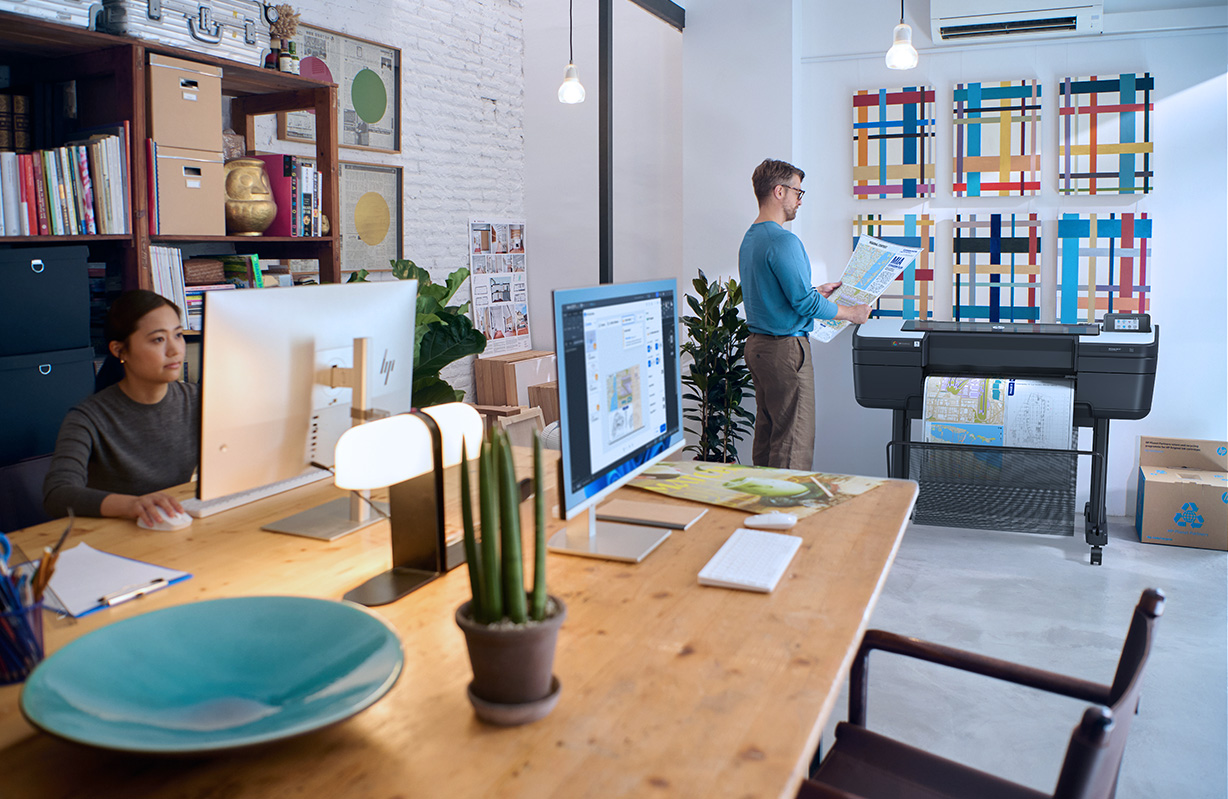
HP has expanded its large format printing portfolio with the launch of the HP DesignJet Z6 and Z9+ PostScript Printer Series Plus Edition, designed to deliver improved image quality, workflow automation and higher productivity for print businesses.
The new series builds on a DesignJet platform that HP says has more than 40,000 units installed worldwide. Combining technologies from the previous Z6 and Z9 models, the latest printers are aimed at businesses producing professional photography, retail graphics, posters and technical drawings.
Targeting small and medium-sized print providers, the printers are designed for a broad range of users, including photo studios, copy shops, retailers, educational establishments and architectural practices looking to manage multiple applications from a single device.
According to HP, the new DesignJet range combines HP Pixel Control technology with HP Vivid Photo Inks to produce sharp detail, smooth colour gradients and water- and fade-resistant prints. The company also says its dual-drop technology delivers high-quality output without the need for additional light inks, helping to simplify the ink system while maintaining image quality.
The HP DesignJet Z9+ Plus Edition has been developed for colour-critical applications, including professional photography and premium graphics production. It features an embedded spectrophotometer for automatic colour calibration, while an optional HP Gloss Enhancer is available to improve gloss uniformity across printed output.
Alongside improvements in image quality, HP has introduced a range of features aimed at increasing production efficiency. The company says new print modes can increase output by up to 90% in certain production scenarios, while dual-roll capability, automatic roll switching and an integrated vertical trimmer on selected models are designed to reduce manual intervention and minimise finishing times.
In addition to the hardware upgrades, HP has strengthened the software ecosystem surrounding the new DesignJet range. Enhanced integration with the HP Click App and Driver is designed to simplify job submission and print preparation, enabling users to process files more efficiently and improve workflow across multiple print applications.
HP has also incorporated HP Wolf Pro Security into the new printer series, providing built-in protection against cyber threats and helping businesses safeguard connected devices, print jobs and sensitive business data as production environments become increasingly digital.
HP expands PrintOS Production Hub
Alongside the printer launch, HP has announced a series of enhancements to HP PrintOS Production Hub. The latest updates include a new Order Approval feature, allowing customers to review and approve jobs before production begins, helping to reduce errors and unnecessary reprints.
HP has also introduced an Orders API, enabling PrintOS Production Hub to integrate with CRM, ERP, MIS and accounting systems to automate order management across existing software platforms. Completing the update is a new AI Upscale Image feature, designed to improve the quality of lower-resolution artwork during file preparation and reduce the need for manual image enhancement before printing.
Commenting on the launch, Daniel Martinez, Senior Vice President and Division President of HP Large Format Printing, said:
"Print businesses today need to do more with less – faster turnaround, broader applications and consistent quality. The HP DesignJet Z6 and Z9+ PostScript Printer Series Plus Edition has been developed to deliver the precision, quality and productivity customers need to grow their businesses profitably."
The HP DesignJet Z6 and Z9+ PostScript Printer Series Plus Edition is expected to be available in the UK from early to mid-July 2026.